
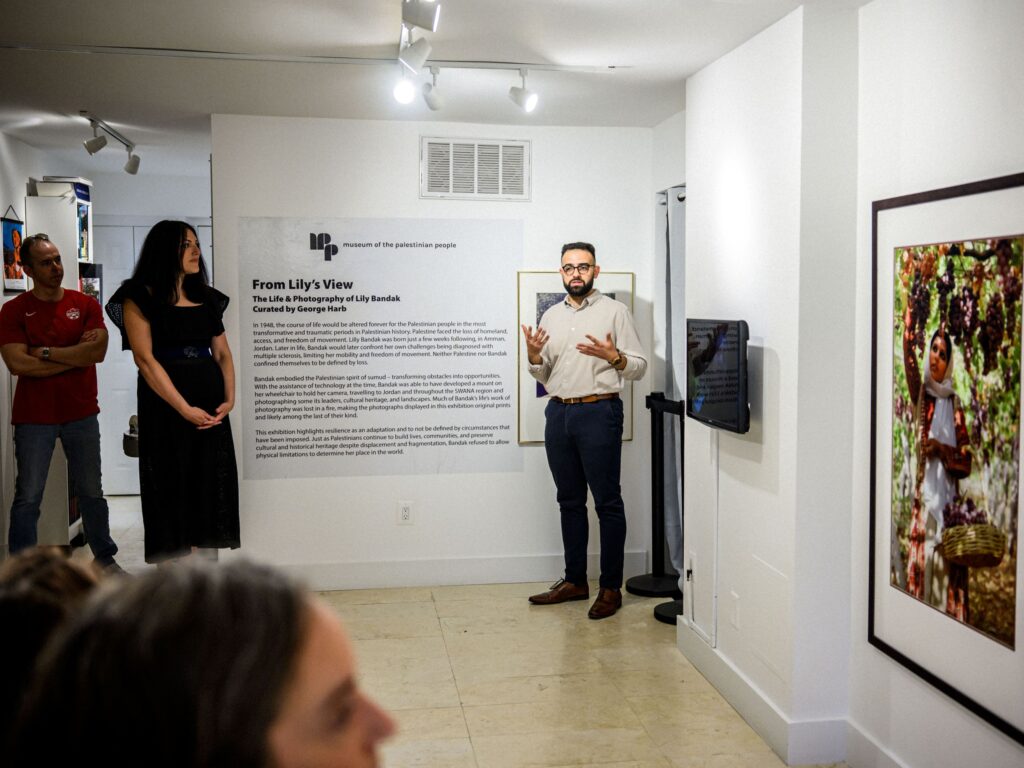
From Lily’s View: The Life & Photography of Lily Bandak presents a remarkable series of portraits documenting Palestinian traditional dress, cultural heritage, and beauty through the distinctive photographic vision of pioneering photographer Lily Bandak, whose work was created from her wheelchair.
From Lily’s View celebrates the work of the late Lillian “Lily” I. Bandak (1948-2021), a Palestinian American photojournalist whose photography reflects a lifelong commitment to documenting Palestinian history, beauty, and cultural heritage. This exhibition presents a selection of surviving photographs, signed and mounted by Bandak and preserved by her family. They are hung on the wall at a height intended for seated visitors, and the museum encourages everyone to have a look From Lily’s View.
From Lily’s View celebrates the work of the late Lillian “Lily” I. Bandak (1948-2021), a Palestinian American photojournalist whose photography reflects a lifelong commitment to documenting Palestinian history, beauty, and cultural heritage. This exhibition presents a selection of surviving photographs, signed and mounted by Bandak and preserved by her family. They are hung on the wall at a height intended for seated visitors, and the museum encourages everyone to have a look From Lily’s View.
Born on July 31, 1948, in Amman, Jordan, to a Palestinian family from Bethlehem, Bandak was born during al-Nakba (“the Catastrophe”), the 1948 mass displacement of more than 750,000 Palestinians from their homeland. Al-Nakba is the seminal event that marks and defines contemporary Palestinian existence. Throughout her career, Bandak photographed historic sites, cultural landmarks, and prominent public figures from across the Arab world. During the Carter administration (1977–1981), one of her photographs was selected for permanent display at the White House, making Bandak the first Palestinian photographer to be represented in the White House’s permanent collection.
In 1982, while on assignment for Newsweek, Bandak documented the aftermath of the Sabra & Shatila massacre in Beirut, Lebanon. The violence was considered one of the most harrowing massacres committed in the Lebanese civil war – killing every man, woman, and child. Looking back on the experience decades later in an interview with Ability Magazine (2015), she described the assignment as profoundly traumatic and believed it marked the beginning of the illness that was later diagnosed as Multiple Sclerosis (MS). As the disease increasingly limited her mobility, Bandak adapted through assistive technology mounted to her wheelchair and reinvented her approach by continuing to photograph with remarkable courage and determination. Bandak believed that “where there is a will, there is a way.”
In 2012, a fire destroyed Bandak’s home and studio, consuming her photographs, negatives, prints, and decades of work. The original prints presented in From Lily’s View survived the devastating loss, and remain among the last authentic works from her lifetime. The museum is deeply grateful to the Bandak family for their generous donation of these signed prints and is honored to preserve and steward Bandak’s artistic legacy through the permanent collection.
Bandak passed away on September 11, 2021, leaving behind a legacy of perseverance, artistic excellence, and an invaluable record of Palestinian cultural heritage. She regarded disability as an integral part of her lived experience and responded to its challenges with ingenuity, determination, and creativity. Her photographs reflect a lifelong commitment to preserving the beauty of Palestine while demonstrating that innovation can emerge from adversity. Through both her art and her example, Bandak hoped to inspire future generations of disabled Palestinians to pursue their aspirations, adapt to challenges, and recognize that their perspectives and contributions are invaluable.
This exhibition is dedicated to the hundreds of thousands of Palestinians living with disabilities across Gaza and the West Bank, and whose perseverance serve as prolific examples of Palestinian survival and resistance.
Read about the photographs in the exhibition in the museum’s online collection: https://hub.catalogit.app/…/from-lilys-view
Ability Magazine. “Lily Bandak: Clear Focus.” Accessed July 16, 2026.
https://abilitymagazine.com/…/lily-bandak-clear-focus-2/
The Jerusalem Fund. “Lily Bandak: A Life’s Work in Pictures.” May 7, 2018. Accessed July 16, 2026.
https://thejerusalemfund.org/…/lily-bandak-a-lifes-work-in-pictures/
The National. “Video: Photographer Lily Bandak Speaks About Her Career in Photography and Disability in the Arab World.” Accessed July 16, 2026.
https://www.thenationalnews.com/…/video-photographer-lily-bandak…
Tribute Slides. “Lily Bandak.” Memorial tribute. Accessed July 16, 2026.
https://www.tributeslides.com/…/S5PZGX494XZ2CSHR
Wafa Ghnaim is a dress historian, embroiderer, educator, and the founder of the Tatreez Institute. She is the author of Tatreez & Tea (2016) and THOBNA (2023), and a former research scholar at the Metropolitan Museum of Art. She is now Senior Research Fellow at the Museum of the Palestinian People for the Mellon Foundation funded project, Bayt wa Balad: Home & Homeland.
George Harb is the director of Exhibitions and Programs and is a second-generation Palestinian American independent artist, digital archivist, curator, and community historian based in Washington, D.C.,.