Community, Identity, and Continuity: A Century of Sports in Palestine
On view from August 21, 2026
in collaboration with:
Drawing on photographs, club records, documents, infographics, and other archival materials, Dis-play-ced traces more than a century of Palestinian athletic history. By bringing together historical and contemporary materials, the exhibition examines how sport has been shaped by changing political and social conditions and how athletic traditions have continued to carry the Palestinian national identity across generations.
Through the histories of clubs, schools, teams, religious institutions, and athletes, Dis-play-ced presents sport as a lens through which to understand Palestinian communities, their experiences, and the ongoing relationship with athletic life.
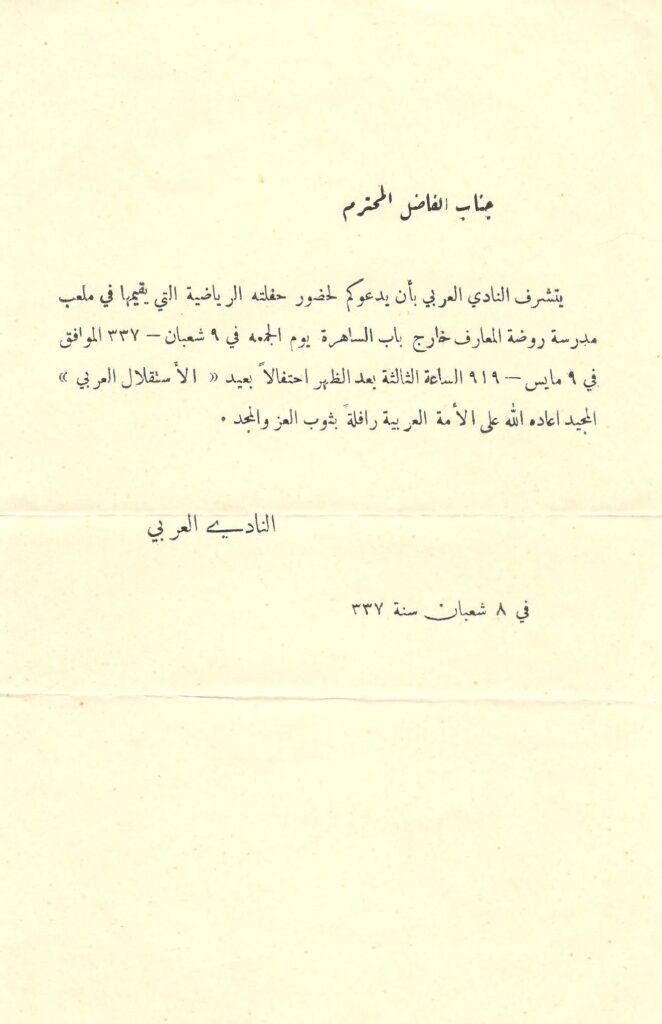
An Invitation to Attend a Sports Event at the Arab Club, Jerusalem, 1919 The Palestinian Museum Digital Archive Sa'eed al-Husseini Collection Accession Number, 0012.01.0059
Community
Athletic traditions in Palestine are deeply rooted, with organized clubs, leagues, and competitions dating back to the late Ottoman period and expanding under the British Mandate. By the 1920s and 1930s, cities and towns including Jerusalem, Jaffa, Gaza, Ramallah, Nablus, Hebron, Jenin, Tulkarm, Birzeit, and Anabta were home to football clubs, scouting groups, gymnastics societies, and athletic associations.
Organizations such as the Arab Club of Jerusalem (al-Nādī al-ʿArabī), Anabta Sports Club (al-Nādī al-Riyāḍī al-ʿAnbatāwī), and Sareyyet Ramallah (the First Ramallah Scout Group), alongside school athletic programs at al-Ma’aref National College and the Ramallah Friends Schools, became important centers of athletic, educational, and civic life. Religious institutions and community organizations also established sports groups, youth activities, and athletic programs that brought people together across neighborhoods and communities. These organizations created spaces for social connection, youth development, public engagement, and a collective Palestinian identity through sport.
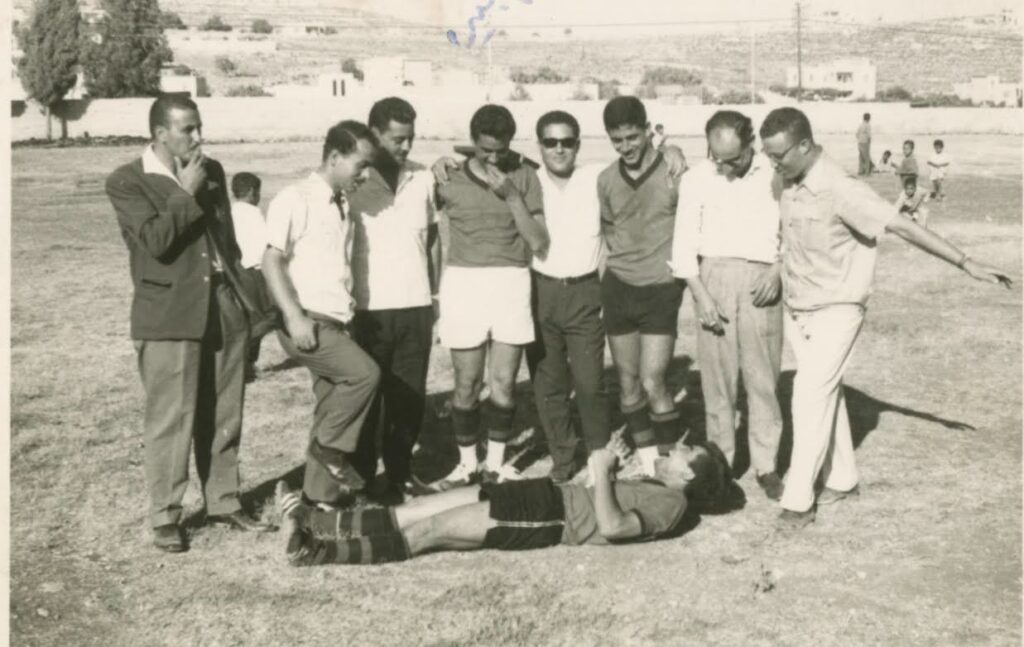
Men in a Sports Club, ca. 1950s-1960s The Palestinian Museum Digital Archive The Rajab Shaheen Collection, Accession Number, 0189.01.0046
Identity
The growth of organized football also reflected the political inequalities of the Mandate period. The Palestine Football Association, recognized by FIFA in 1928, was dominated by Zionist clubs, with the intentionality to assert the Jewish national identity over Palestine, leaving the Palestinian Arab clubs as a minority. The Palestine national team that competed internationally during the 1930s consisted exclusively of European Jewish players, despite representing Mandatory Palestine.
In response, Palestinian Arab clubs established the Arab Palestine Sports Federation in 1931, organized their own competitions, and developed networks that supported Arab athletes and athletic organizations. Athletic clubs became spaces where Palestinian communities developed institutions, created networks, and expressed forms of local and collective identity. Although some clubs were established under the auspices of religious institutions, they were generally secular in character and welcomed members from different religious backgrounds.
The end of the British Mandate and the rise of the State of Israel, known to Palestinians as the Nakba, marked not only loss of homeland, but of ecosystems, traditions, cultures, heritage, and social life. Many clubs had disappeared, relocated, or were reestablished as Palestinians had become victims to both displacement and institutional loss. In refugee camps and Palestinians in the diaspora, new athletic organizations emerged. Clubs such as Nadi al-Wihdat in Jordan, established in 1956 by Palestinian refugees in Amman, and Club Deportivo Palestino in Chile, founded in 1920 by members of the Palestinian community in Santiago, demonstrated the need for creating institutions to maintain the strength and rootedness of the Palestinian identity.
This is a joint exhibition of the Museum of the Palestinian People and the Palestinian Museum in BirZeit, Palestine.